Sea Traffic
Cargo ships, carrier groups, ferries and small boats, plus lit harbours.
- Version
- Version 0.5.0
- Works with
- SimplePlanes 2 0.7.9
- Updated
- Category
- Traffic
- Online
- Host onlyExperimental: still has bugs in multiplayer
- Needs
- BepInEx 5. The Gravy Mod Menu is recommended.
- Credits
- Sounds and sources
What it does
Ships for SimplePlanes 2. Keeps cargo ships, aircraft carrier groups and squadrons of fast attack boats sailing around you. Cargo ships run between real harbours, warships patrol, and every route keeps well clear of land, including the islands added by the Classic Islands mods. Closer in, the coasts fill with small boats: sailboats, speedboats, jet skis, fishing boats, motor yachts, tugs and ferries. Harbours get ships moored at their quays, and at night every ship and harbour lights up.
Features
- Cargo ships, giant container ships (600–900 m by default), sail between harbours: New Yoke, Cochran, Bannock, Kunimitsu, Daland, Coughinton and Vetusta, plus Wright Isles, Sky Park City, Krakabloa, Maywar and Snowstone when those islands are installed. They anchor off a port for a few minutes, then head for another one.
- Carrier groups: SP2's aircraft carrier with up to four destroyer escorts in formation, patrolling a loop of open sea. The deck is solid, so you can land on a moving carrier.
- Attack boat squadrons: helipad-equipped destroyers in echelon, weaving at about 50 m/s. Optionally hostile in single player: they fire missiles at you when you come within range.
Sea lanes are planned on a land/water map built from:
- the game's own world heightmap;
- every terrain tile as it loads;
- the Classic Islands, Breadcrumbs and Cthulhu mods at the positions set in their settings.
Ships keep at least 1.5 km off the coast, turn with realistic turning circles and re-plan if a newly loaded coastline blocks their way.
- Small boats along the coasts near you (see below).
- Docked ships: container ships, tugs and yachts moored alongside the quays of the harbours near you, a few per harbour. They ride the swell gently and stay where they are.
- Ship lights at night, visible tens of km away:
- under way: white masthead lights, red (port) and green (starboard) sidelights and a white stern light, each only visible from its proper side, as on a real ship;
- stopped (at anchor or moored): white anchor lights fore and aft;
- warm window lights on the bridge and superstructure, and deck lights;
- carriers: flight deck edge lights, floodlights and a red light on the island;
- small boats carry weaker lights, seen a few km off (see below).
- The game's own moored ships get anchor and window lights too.
Show the restHide the rest
- Harbour lights at night: sodium lamps along the quays, walkway lamps every 30 m along both edges of piers and jetties, red aviation lights and floodlights on the cranes, flashing red and green lights on the pier heads, and lighthouses. This includes the Bannock Industrial naval yard next to the power plant west of Bannock (its piers, carrier dock, dry dock and cranes).
- Lighthouses: a small lit lantern at the top of the tower, with two beams turning slowly (one turn every 12–19 s). Each time a beam sweeps past you, the lantern gives a short, bright flash, so you see a flash every 6–10 s from any side. The beams are thin, faint shafts of light about 2.5 km long, narrow at the lantern and widening slightly. They point just below the horizon and stop where they meet the sea, land or a building. They show most in haze, fog, rain and under cloud, and are faint on a clear night. Fog also shortens them.
- Wakes behind moving ships, and small boats ride the swell and lean into turns.
Ship sounds: engines and bow waves on the nearest vessels (6 by default), positioned on each ship and boat:
- cargo ships, carriers, destroyers and ferries: a deep diesel rumble, lower for bigger, slower hulls and a little higher for destroyers, heard 1.2–2 km off;
- tugs, fishing boats, motor yachts, speedboats and sailboats under motor: an outboard, its pitch and loudness set by the boat's size and speed. Speedboats rev up and get louder on the plane. Attack boats get a higher-pitched, louder outboard heard up to about 900 m;
- jet skis: their own engine sound, revving as they zig-zag;
- every vessel under way: the wash of its bow wave, louder with speed and size, heard only within a few hundred m;
- stopped ships idle quietly; moored ships give a dull generator hum close by; moored small boats are silent.
Sound falls off with distance, loses its highs far away, shifts slightly in pitch as ships pass (a mild Doppler effect), and is muffled in cockpit view. It pauses with the game, stops in the designer and when you leave the flight, and follows the game's master volume.
- In single player, ships take damage from your guns, missiles and bombs, and sink. They can also be made lockable targets.
- Built for performance:
- ships run on precomputed routes, with no physics simulation;
- distant ships are hidden (their lights stay on at night);
- shadows are only drawn up close, and colliders only within a set range.
- In multiplayer, only the host gets ships, and there they're scenery (see Multiplayer below).
Small boats
Show small boatsHide small boats
Small craft keep the water near the coast busy. They only appear where there's coast within a few km of you, so out on the open ocean you'll only meet the big ships.
| Boat | Where | What it does |
|---|---|---|
| Sailboat (8–12 m sloop) | Coast and bays, 100 m – 3 km off | Sails at 3–8 m/s depending on the wind and its angle to it. Beats upwind in tacks and goes about now and then. Heels to leeward and swings its boom and jib out to the wind. Uses the game's wind, or a gentle sea breeze in a calm. |
| Speedboat (7–11 m) | Coast and bays | Runs between bays at 18–28 m/s with a long foam wake, bow up on the plane, leaning into turns. Sometimes stops for a while. |
| Jet ski | Off beaches (gently sloping sand, not quays or cliffs), daytime only | Zig-zags at 13–19 m/s close inshore, with the odd doughnut. |
| Fishing boat (12–18 m) | Fishing grounds 0.5–7 km offshore | Steams to a spot at about 6 m/s, then works it in slow circles for a few minutes before moving on. |
| Motor yacht (22 m) | Coast, often near harbours | Cruises at 9–12 m/s, sometimes drops anchor in a bay for a few minutes. |
| Tug | Around harbours | Potters about the harbour approaches at 5–6 m/s, stopping now and then. |
| Ferry (88 m double-ended car ferry) | Between neighbouring harbours, e.g. New Yoke and Bannock | Crosses at about 12 m/s on a route planned along the sea lanes. It eases into the terminal and waits a couple of minutes. Then it sets off back the other way, being double-ended. |
- Every boat stays in water deep enough for it. Each leg is checked before it's taken, and a few times a second the boat looks ahead and turns away from shallows, land, piers and breakwaters. The checks are fine-grained (rays straight down onto the ground, the sea floor and harbour structures), so boats can work close inshore.
- Boats keep clear of each other, of the big ships (they always give way) and of you. When you're low over the water (landing on it, taking off from it, or in a boat) they also stay out of the stretch of water ahead of you. Ferries hold their course and slow down until the way is clear.
- Lights at night, following the rules of the road for small craft:
- sailboats: red/green sidelights and a white stern light under way, a white light at the masthead at anchor;
- speedboats and jet skis: an all-round white light and sidelights;
- fishing boats: red over white all-round lights (a vessel fishing), sidelights, a stern light and deck working lights;
- the motor yacht and tugs: masthead, sidelights and stern light, anchor light when stopped;
- ferries: two masthead lights, sidelights, stern light, rows of lit windows and deck lights.
- Lightweight, like the big ships:
- small boats are hidden beyond a few km, cast shadows only up close, and their wakes only run within 2.5 km of you;
- jet skis and sailboats get a foam-only wake;
- boats left behind are removed and new ones appear around you, so the count stays capped.
- Wakes are sized to the boat. Jet skis and sailboats leave foam only, with no wave. A fishing boat raises about 10 cm of wake wave and tugs about 25 cm. Speedboats and the yacht raise up to about 30 cm, and only at speed. Ferries raise a moderate wake of about 60 cm. The wave fades during hard turns, so a boat doing doughnuts leaves a ring of foam rather than a ring of wave.
- Single player, or the host in multiplayer only (as scenery), as with the other ships.
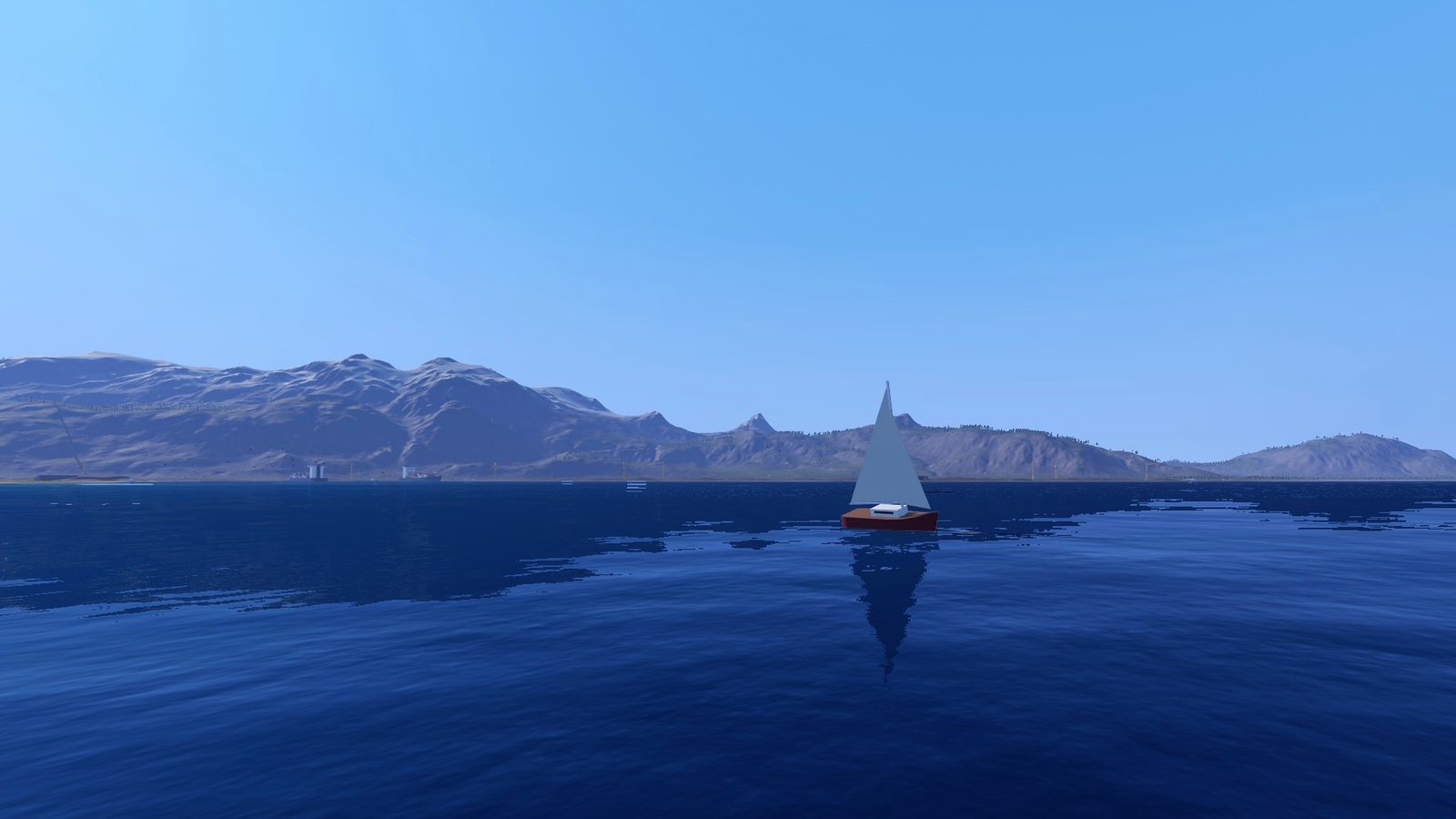 (open larger)
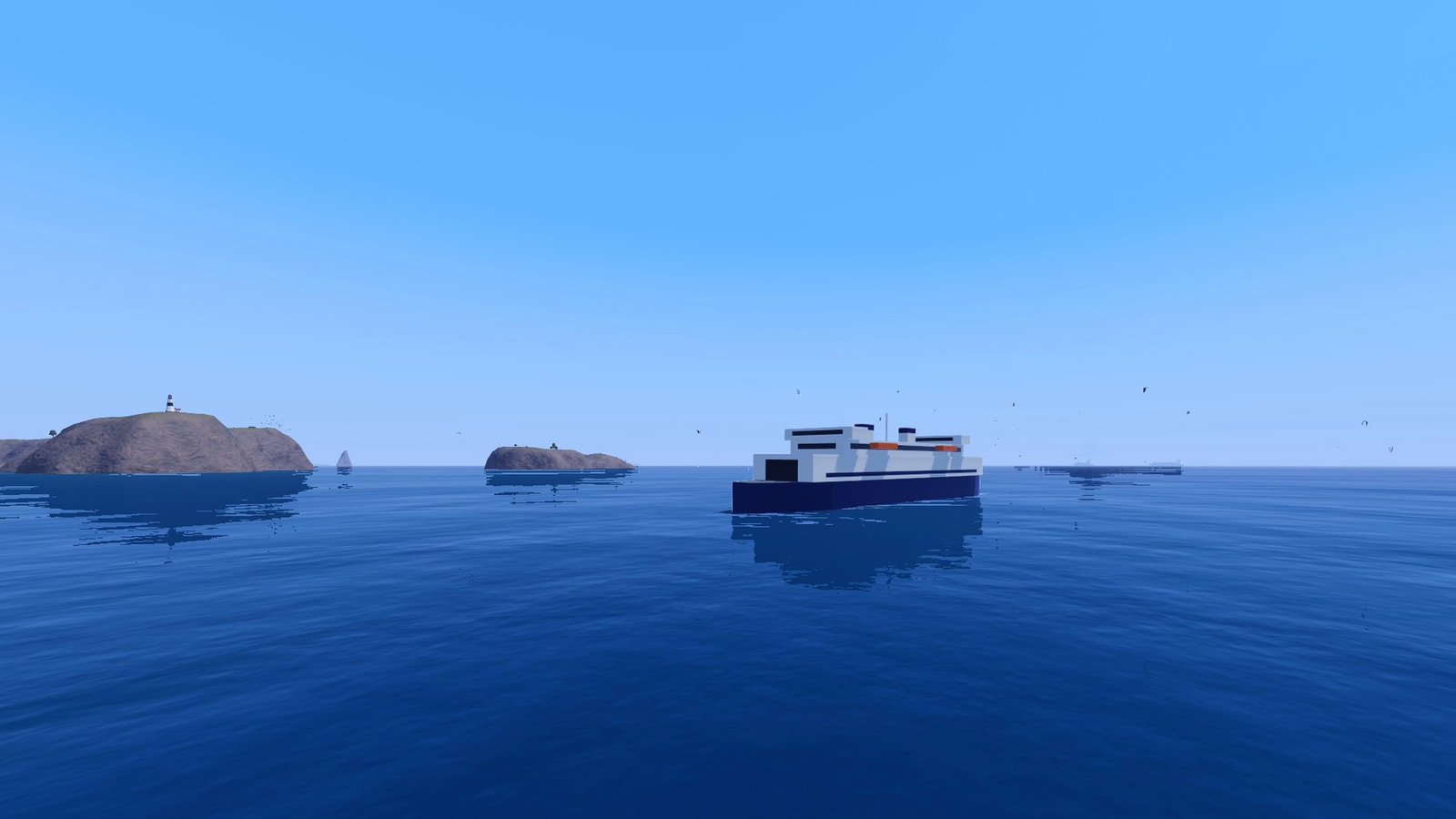 (open larger)
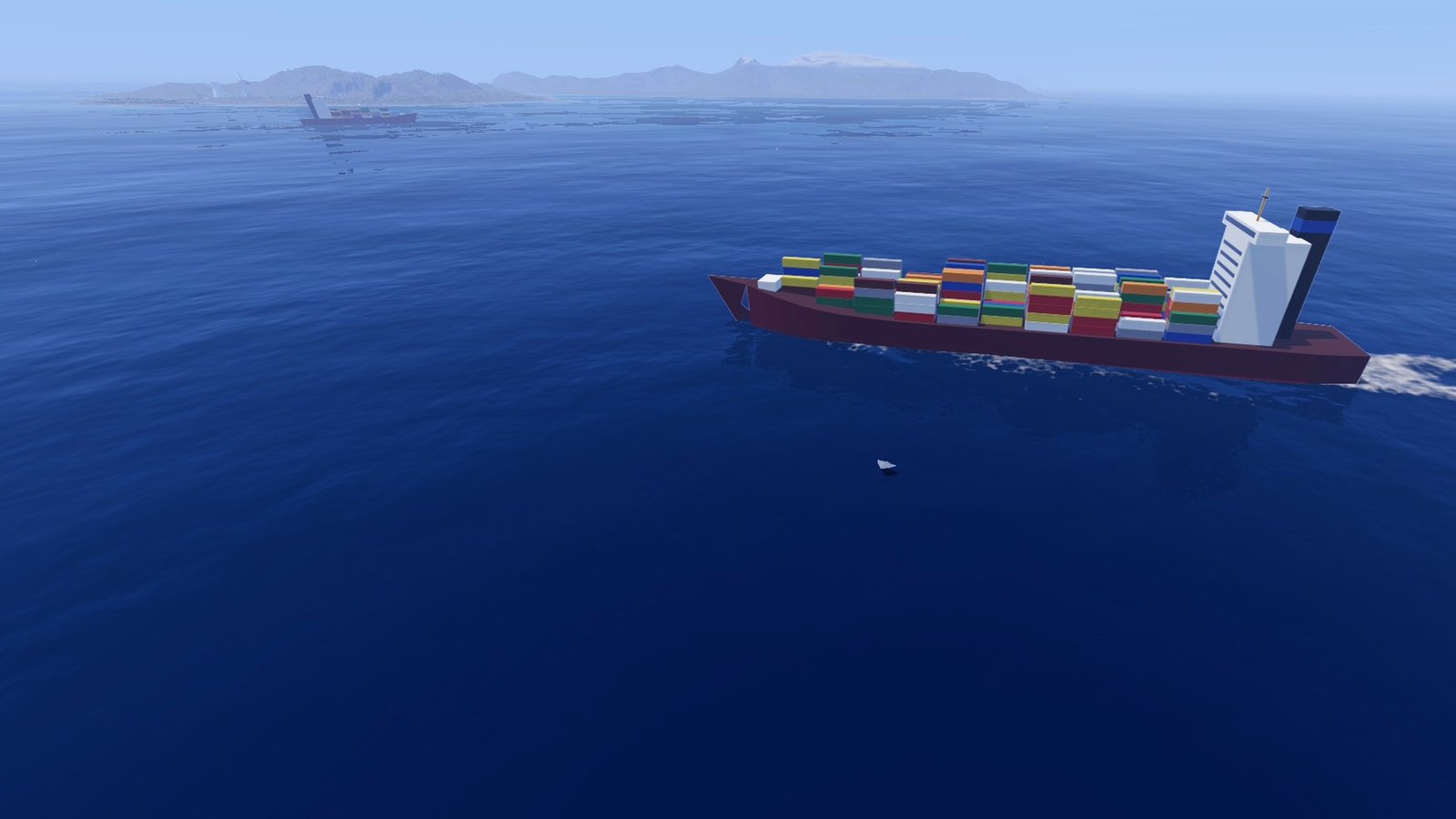 (open larger)
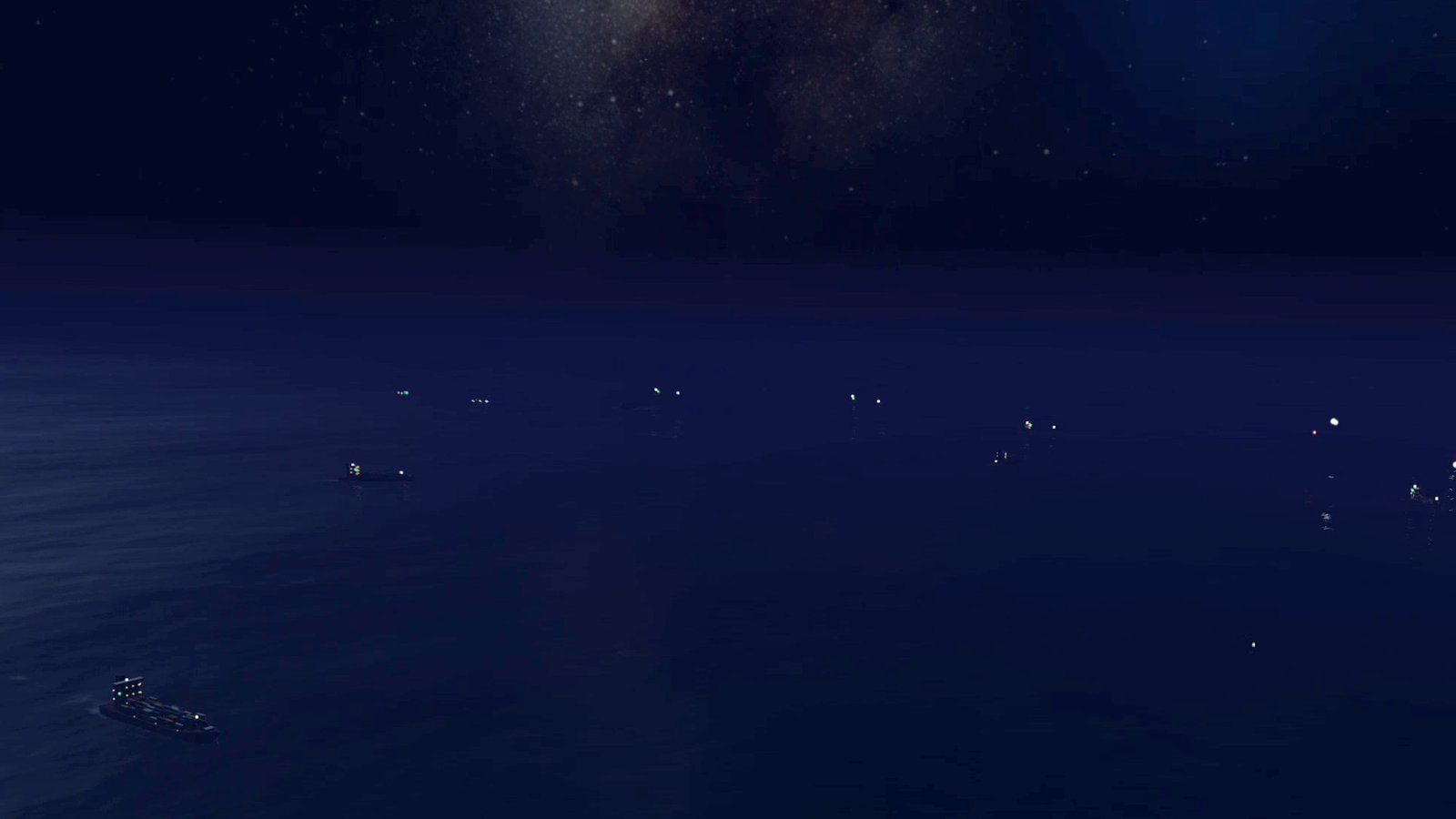 (open larger)
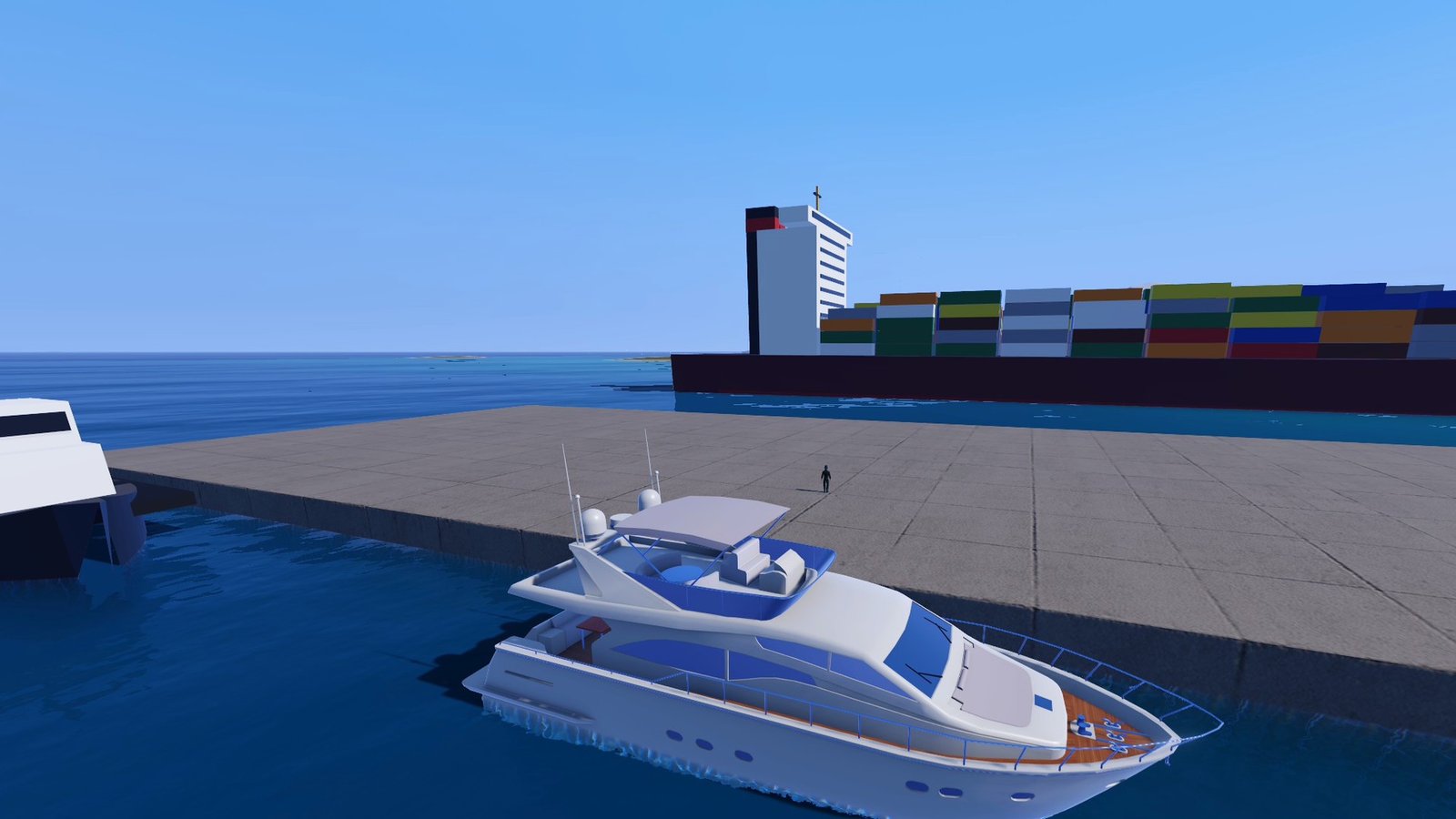 (open larger)
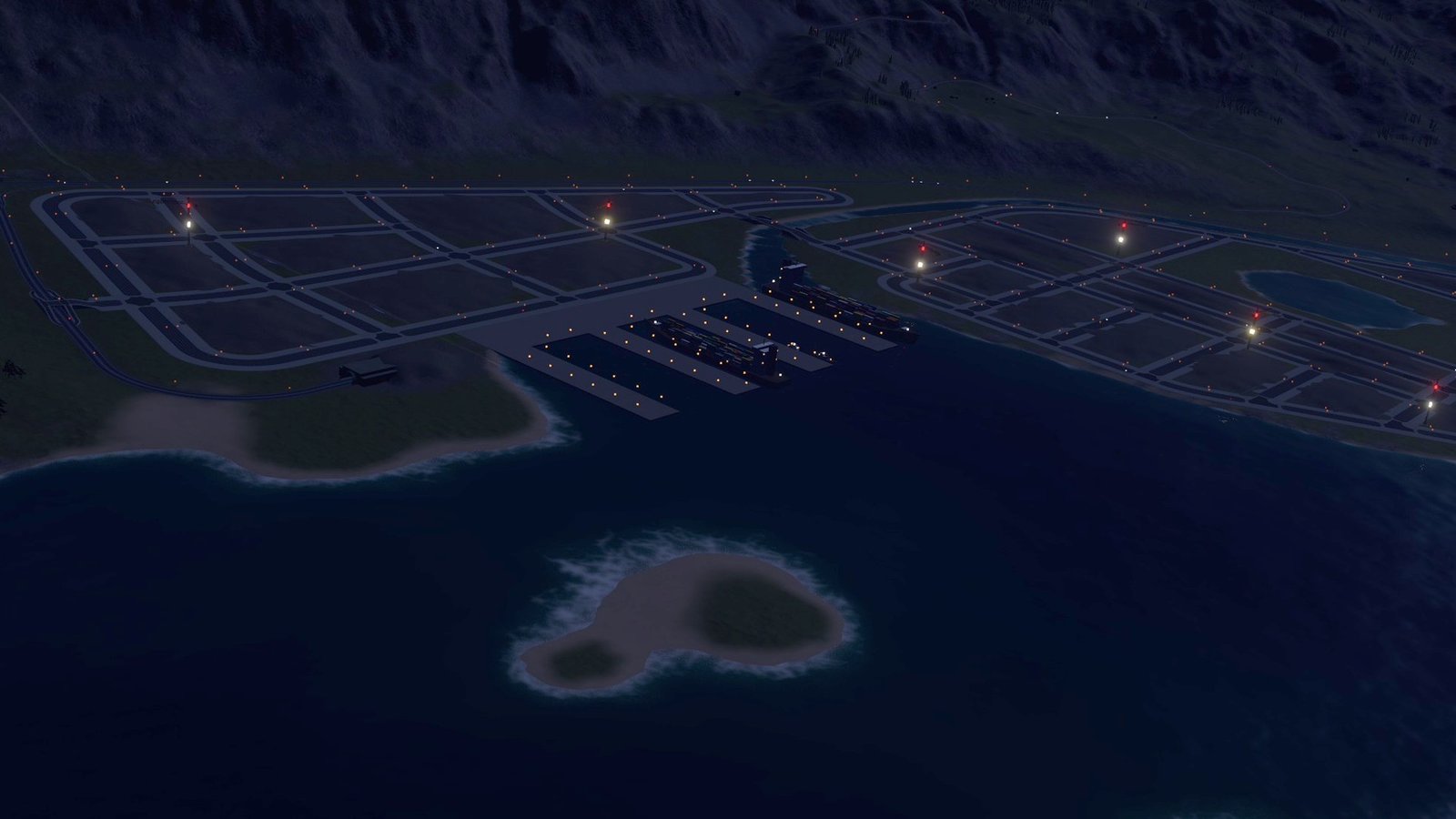 (open larger)
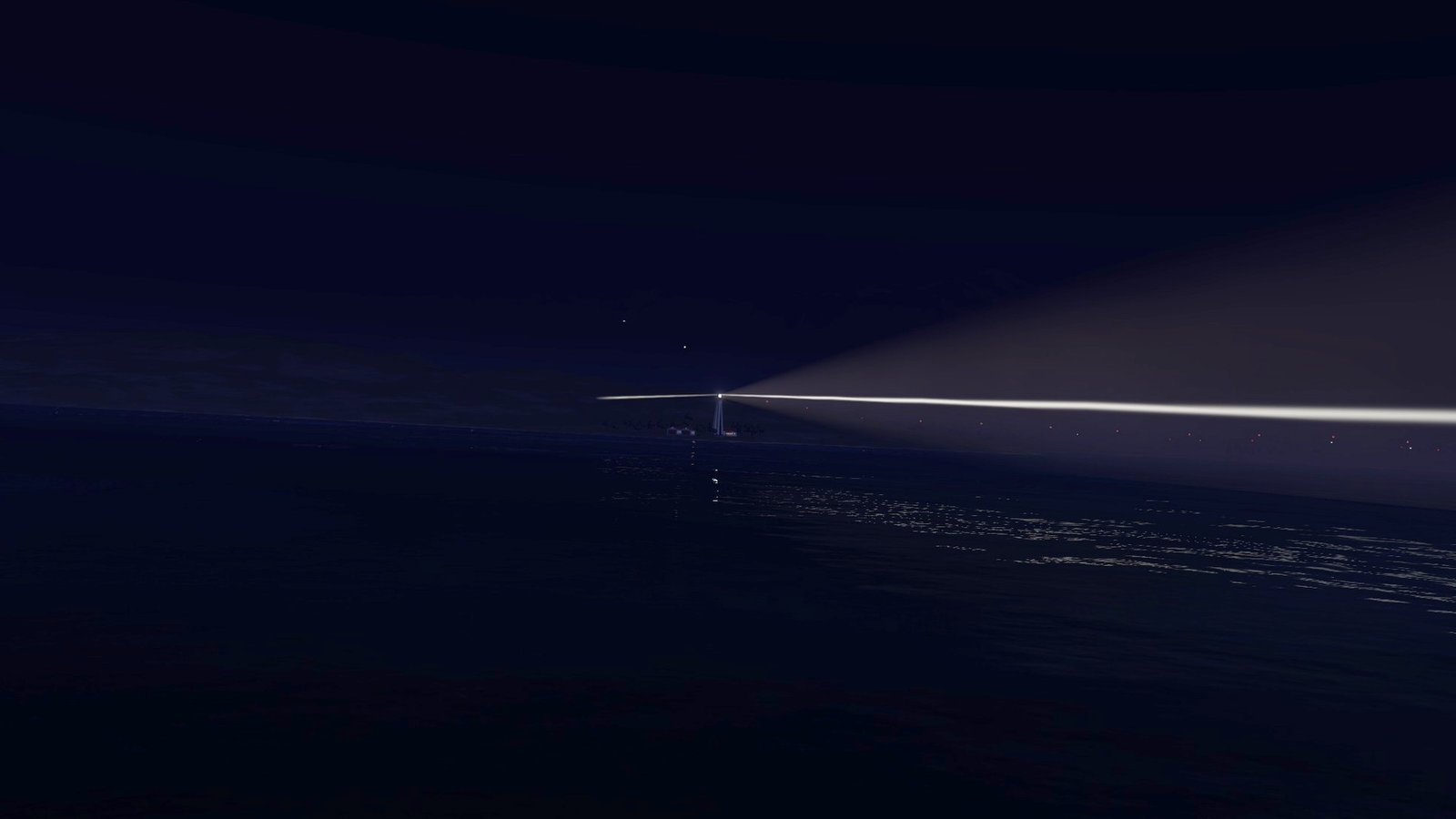 (open larger)
How harbours are found
Show how harbours are foundHide how harbours are found
Harbours come from SeaTraffic's port list (plus a few harbours that aren't ports of call, such as the Bannock Industrial naval yard) and from the game's own world objects with port, pier, dock, harbour, quay, wharf, jetty or marina in their names, as they load near you. Cranes and lighthouses are found by name too. Parts of a location that the game's occlusion culling is hiding at that moment (because they're behind a hill from where you are) are included, so a harbour that loads while you're far away is still found in full.
When you come within a few km of a harbour, SeaTraffic maps it once in the background, at 8 m resolution, with rays straight down. Each spot is classed as open water, land, a low structure (pier, quay, dock) or a tall one. Quays are the straight edges where a structure meets open water. Piers and jetties are the long, narrow decks with water on both sides, also where they join a quay. Ships are sized to fit their berth, and are only placed where the whole hull, plus a margin, lies over open water. So they never sit on land or cut through a pier. Everything is chosen from the harbour's name, so ships moor at the same spots every time.
The log (BepInEx/LogOutput.log, lines starting with Harbours:) lists every harbour, quay, pier head, crane, lighthouse and moored ship found. Harbour lights are also saved in BepInEx/cache/SeaTraffic/harbour-lights.txt, so they show from far away on later flights.
Usage
Show usageHide usage
Settings and controls live in the Gravy Mod Menu (Sea Traffic tab) if that mod is installed. It shows:
- live status: how many fleets are out, the sea-lane map, and what each fleet is doing (speed in knots, distance);
- the small boats around you by type, and each ferry (where it's bound, speed, distance, or when it leaves);
- how many harbours were found and mapped, docked ships, how many lights are drawn, and which vessels you can hear;
- Spawn Cargo Ship, Spawn Carrier Group, Spawn Attack Boats, Spawn Small Boats, Spawn Ferry, Despawn All, Rebuild Sea Lanes and Rescan Harbours buttons;
- every setting below.
Without it, edit the .cfg file.
The spawn buttons put the new fleet a few kilometres away, ahead of you if there is open water there. Spawn Small Boats adds three small boats within 2.5 km (if there's coast). Spawn Ferry puts a ferry on the nearest crossing. Despawn All clears the sea, but the counts in the Traffic and Small Boats settings refill it within seconds: set them to 0 (or turn Enabled off) to keep it empty.
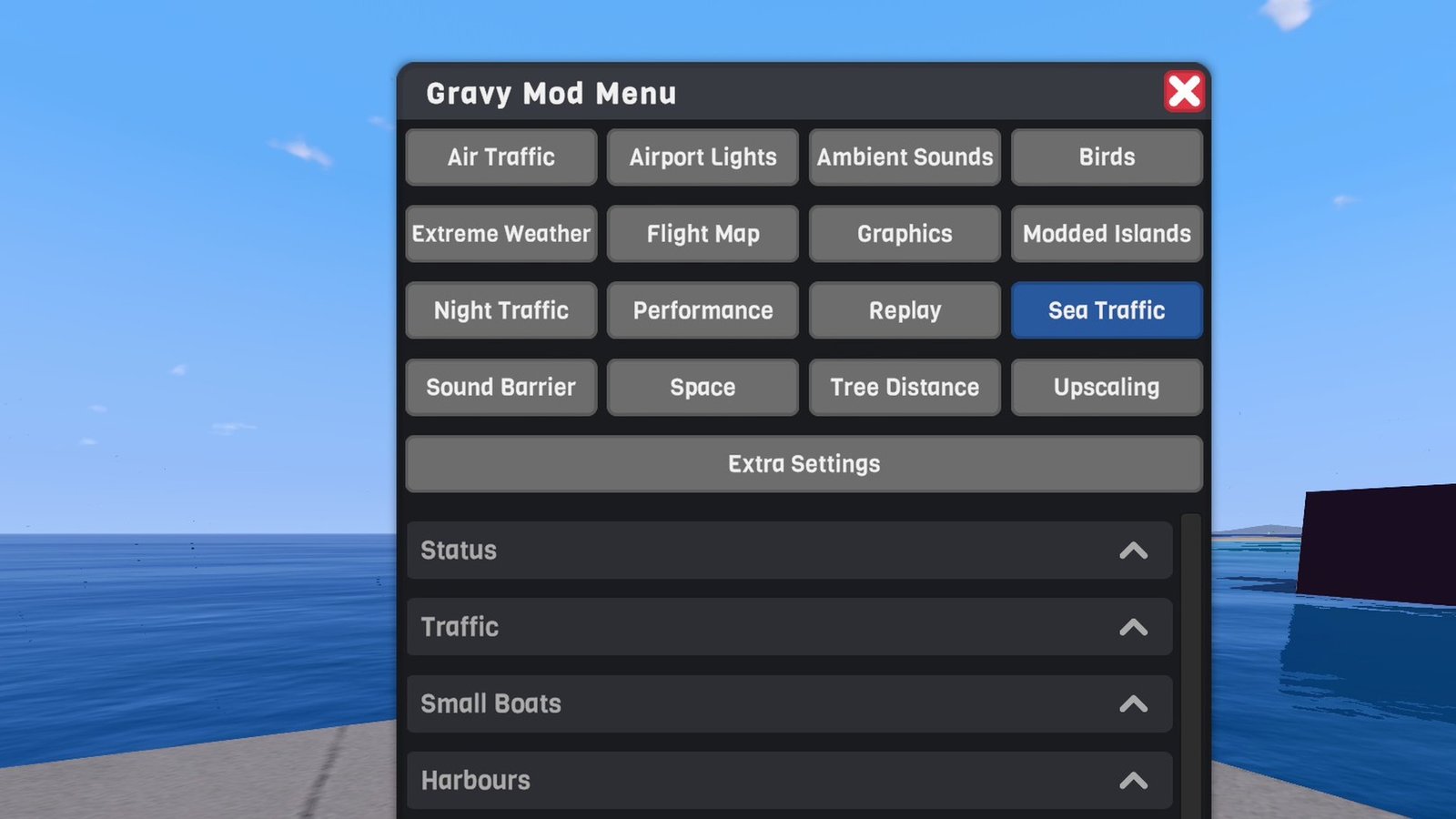 (open larger)
Multiplayer
Show multiplayerHide multiplayer
Experimental online. This mod runs in multiplayer, but it still has bugs there that aren't fixed yet. It works best in single player for now.
Host only. Ships and boats only exist on the computer that spawned them; nothing is sent to other players, and they don't need the mod.
- Single player (no other human in the game; AI crafts don't count): everything, with solid ships you can land on, shoot, sink and (optionally) lock onto, and attack boats that can fire at you.
- Hosting with other players: the ships, small boats, ferries and moored ships stay (
AllowInMultiplayer, on by default), but only you see them, so they're scenery: no collisions, so you never land on or shoot at something the other players can't see. They can't be targeted, damaged or sunk, and attack boats don't fire. TurnAllowInMultiplayeroff to clear the sea while others are connected. - Joining someone else's game: no ships or boats. The harbour lights and the night lights on the game's own moored ships still show, since they're purely local.
- Ship sounds play only where there are ships, so in multiplayer only the host hears them.
Settings
Show all settingsHide settings
| Section | Setting | Default | Notes |
|---|---|---|---|
| Traffic | Enabled | true | |
| Traffic | CargoShips / CarrierGroups / AttackSquadrons | 4 / 1 / 1 | Fleets kept around you |
| Traffic | SpawnRadiusKm | 30 | Spawn radius; despawn beyond 1.6× |
| Traffic | AllowInMultiplayer | true | Keep the ships when hosting with other players (only you see them; scenery: no collisions, targets or damage) |
| Small Boats | SmallBoats | true | Small boats and ferries along the coasts |
| Small Boats | SmallBoatCount | 12 | Small boats kept around you (0–40; ferries not included) |
| Small Boats | SmallBoatRangeKm | 6 | They appear within this distance and are removed beyond 1.5× |
| Small Boats | Sailboats | true | |
| Small Boats | SpeedboatsJetSkis | true | Speedboats & jet skis (jet skis by day only) |
| Small Boats | FishingBoats | true | |
| Small Boats | YachtsTugs | true | Motor yachts & tugs |
| Small Boats | Ferries / FerryCount | true / 2 | Ferries between neighbouring harbours, one per crossing (1–4) |
| Harbours | DockedShips | true | Ships moored at harbour quays |
| Harbours | DockedShipsPerPort | 4 | At most this many per harbour (0–12; fewer if the quays are short) |
| Lights | ShipLights | true | Ship lights at night |
| Lights | HarbourLights | true | Quay lamps, crane lights, pier-head lights, lighthouses at night |
| Lights | LighthouseBeams | true | The lighthouses' rotating beams (off: the lanterns still flash) |
| Lights | BeamBrightness | 1 | How bright the lighthouse beams are (0.1–4) |
| Lights | LightBrightness | 4 | How bright the lights glow |
| Lights | LightSize | 5 px | Smallest size of a light on screen, however far away |
| Lights | LightDistanceKm | 40 | Lights are drawn out to this distance (dim deck lights less far) |
| Lights | LightsInDaytime | false | Testing: show the night lights by day too |
| Sounds | ShipSounds | true | Engine and bow-wave sounds from nearby ships and boats |
| Sounds | Volume | 80% | Volume of the ship sounds (0–150%, on top of the game's master volume) |
| Sounds | MaxAudibleVessels | 6 | How many of the loudest nearby vessels are heard at once (1–12) |
| Ships | CargoSpeed / CarrierSpeed / AttackBoatSpeed | 25 / 35 / 50 m/s | Sized for SP2's world; cargo ships and boats vary by ±10% |
| Ships | CargoShipScale | 4 | Size of the built-in container ships (1 = real-world 150–230 m) |
| Ships | EscortsPerCarrier / BoatsPerSquadron | 3 / 4 | |
| Ships | CarrierModels | CarrierLarge | SP2 ship models, separated by | |
| Ships | EscortModels | Destroyer| | |
| Ships | CargoModels | Cargo | Cargo = built-in container ship |
| Ships | AttackBoatModels | Old Destroyer | A helipad-equipped destroyer; PatrolBoat = built-in fast attack craft (used automatically if the model is missing) |
| Ships | AnchorMinutes | 3 | Time cargo ships spend at a port |
| Ships | WeaveAngle | 20° | How far attack boats weave |
| Ships | TurnRadiusScale | 1 | Multiplies every turning circle |
| Navigation | ShoreClearance | 1500 m | Minimum distance from land (big cargo ships keep a bit more) |
| Navigation | GridCellSize | 400 m | Resolution of the land/water map |
| Navigation | ExtraObstacles | More areas to avoid: x,z,radius|… | |
| Combat | HostileBoats | false | Attack boats fire at you (single player only) |
| Combat | FireRange / FireInterval / MissileSpeed | 6000 m / 20 s / 250 m/s | |
| Combat | Destructible / Toughness | true / 1 | Ships can be sunk (single player only) |
| Combat | Targetable | false | Every ship can be locked onto (single player only) |
| Performance | HideDistanceKm | 18 | Ships hidden beyond this (lights stay) |
| Performance | ShadowDistance | 1500 m | Shadows only within this |
| Performance | CollisionDistance | 3000 m | Colliders only within this |
| Performance | Wakes | true | |
| Performance | DetailedLog | false | Log every ship, harbour, crane, lighthouse and moored ship (troubleshooting) |
SP2 ship models: CarrierLarge, CarrierLarge 1, Destroyer, DestroyerZumwalt, DestroyerWW2, NuclearSub and Yacht.
Known limitations
Show known limitationsHide known limitations
- Ships are local, so in multiplayer only the host sees them, as scenery (see Multiplayer above).
- The carrier's catapults, arresting wires and elevators don't work, because their scripts are removed. The deck is solid and moves, but the wires won't catch you.
- SP2 has no cargo ship model, so the container ships (and the fallback patrol boat) are simple built-in models.
- Ships anchor about 1.5 km off a harbour rather than entering it. The land/water map is coarse (400 m), so narrow channels aren't used.
- Ships don't avoid each other. Fleets keep their distance when they spawn, but their routes can cross.
- New coastlines are picked up gradually: terrain is sampled a little each frame, and the sea lanes are rebuilt in the background at most every 30 s. Ships may briefly plan around an island's outline box until its terrain has been read.
- Harbours are found by the names of the game's objects and by the shape of what's built at the water's edge. A harbour whose quays are part of the terrain rather than separate objects may get no moored ships. If ships ever moor somewhere odd, the log (with DetailedLog on) shows which quay was used. Rescan Harbours maps everything again.
- Piers narrower than the 8 m map resolution, or T- and L-shaped piers, may get their walkway lamps a little off the middle of the deck or only along part of their length.
- Moored ships stay put; they don't sail off into the sea lanes.
- Small boats only know about land that's loaded near you (with the coarse sea-lane map beyond it). They don't sail under bridges: a bridge deck counts as land.
- Ferries stop at a deep, clear spot off each harbour, as close in as the water allows. They don't come alongside a particular quay. If the harbour isn't loaded yet when the crossing is planned, the terminal is moved in as the ferry approaches. Ferries run only between harbours less than about 28 km apart whose crossing isn't much longer than the straight line.
- Small boats avoid each other and the big ships, but in a tight spot (a busy harbour mouth) two may still pass closer than they should.
- Apart from the motor yacht, the small boats are simple built-in models: SP2 has no other small boat models.
- Lights are glows, not real lights: they don't light up the water or the ships around them.
- Lights fade in at dusk and out at dawn. Seen from above a cloud deck they're dimmed, as the cloud cover would hide them.
- Lighthouse beams stop at land that's loaded (colliders or terrain heightmaps). Over land too far off to be loaded, a beam may reach a little further than it should until that land streams in.
- The lantern's position is read from the lighthouse model: its lantern glass if it has one, otherwise the top of the tower. With DetailedLog on, the log line for each lighthouse says which was used and how high above the sea the lantern is. Lighthouses saved by a pre-release build are dropped from the light cache once and found again as you fly near them.
- Only the main SP2 map is supported.
- Ship sounds are loops played faster or slower for each vessel, not engine simulations. The sounds bypass the game's own mixer: the game's master volume applies, but its effects (cockpit, underwater) are imitated with a low-pass filter.
Requirements
Show requirementsHide requirements
- SimplePlanes 2 0.7.9
- BepInEx 5 (5.4.x, x64 Mono build) installed in the game folder. On Linux/Steam Deck with Proton, add
WINEDLLOVERRIDES="winhttp=n,b" %command%to the game's launch options.
The Gravy Mod Menu is recommended: most mods keep their in-game settings and status there. Without it, edit the .cfg files in BepInEx/config/.